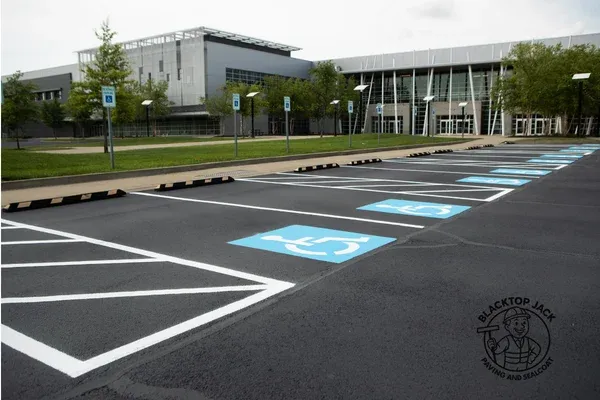
ADA Compliance and Your Parking Lot: What Every Business Owner Needs to Know
Introduction:
An ADA compliant parking lot must include a specific number of accessible spaces based on total lot size (for example, 1 accessible space for every 25 spaces in a lot of 1 to 25), and each space needs proper dimensions, signage, access aisles, and a stable, slip-resistant surface with slopes no steeper than 1:48. If you own or manage a commercial property and you're unsure whether your lot meets today's standards, you're not alone. Many business owners inherit older parking lots with faded markings, cracked pavement, or accessible spaces that were never laid out correctly, and the first sign of a problem is often a demand letter or a customer complaint. Understanding ADA parking requirements before that happens is far cheaper than fixing violations under pressure.
The Problem: Small Oversights, Big Consequences
Most business owners don't intentionally ignore accessibility. The trouble is that compliance isn't a one-time task. Pavement shifts, paint fades, and repairs change slopes over time, so a lot that was compliant when it was built may not be compliant today.
Here are the issues property owners run into most often:
Faded or missing accessible space markings and signage
Cracked, heaving, or sunken pavement in accessible routes that creates tripping hazards
Access aisles that are too narrow, or that have been paved over with a slope that's too steep
Accessible spaces located far from the entrance instead of on the shortest accessible route
Water pooling in accessible spaces due to poor drainage
Not knowing how many accessible spaces the lot is actually required to have
The stakes are real. Noncompliance can lead to complaints, lawsuits, fines, and expensive rush repairs. It also sends a message to customers with disabilities, older visitors, and parents with strollers that your business wasn't designed with them in mind. Accessibility is both a legal responsibility and a smart business decision.
Understanding ADA Parking Requirements
The Americans with Disabilities Act sets minimum design standards for parking facilities serving public accommodations and commercial properties. The 2010 ADA Standards for Accessible Design are the primary reference, and state or local codes may add stricter rules. Here's a summary of the most important rules for surface parking lots.
Requirement | Standard |
|---|---|
Standard accessible space width | At least 96 inches (8 feet) |
Access aisle width | At least 60 inches (5 feet) |
Van-accessible space | 1 of every 6 accessible spaces (minimum of one), with a 96-inch wide aisle or 132-inch wide space |
Maximum slope | 1:48 (about 2%) in any direction within spaces and aisles |
Surface | Firm, stable, and slip-resistant |
Signage | International Symbol of Accessibility mounted at a height that's visible over a parked vehicle |
Access | On the shortest possible route to the entrance that is accessible. |
Vertical clearance for van spaces | At least 98 inches |
Always confirm the exact requirements with your local building department, since state rules can differ from the federal baseline.
How Many Accessible Spaces Does Your Lot Need?
The required number of accessible spaces depends on the total number of parking spaces in your lot. This table shows the general federal minimums:
Total Parking Spaces | Minimum Accessible Spaces |
|---|---|
1 – 25 | 1 |
26 – 50 | 2 |
51 – 75 | 3 |
76 – 100 | 4 |
101 – 150 | 5 |
151 – 200 | 6 |
201 – 300 | 7 |
301 – 400 | 8 |
401 – 500 | 9 |
501 – 1,000 | 2% of total |
Note that certain facilities, such as medical offices and rehabilitation centers, have higher requirements because of the people they serve.
The Solution: A Practical Path to Compliance
Getting your lot into shape doesn't have to be overwhelming. Approach it in stages.
Step 1: Audit your current lot. Count total spaces, measure accessible stalls and aisles, check signage, and walk the route from accessible spaces to your entrance. Look for cracks, uneven joints, and standing water along the way.
Step 2: Check the pavement condition. Accessibility depends on the surface underneath the paint. Cracks wider than a half inch, potholes, and settled sections can make a compliant layout unusable in practice. Slopes also need to be measured, because water damage and shifting soil can push a once-compliant space out of tolerance.
Step 3: Repair before you restripe. Fresh paint on damaged pavement is a short-term fix. Crack sealing, patching, and leveling should come first. If the asphalt has deteriorated widely, parking lot resurfacing can restore a smooth, stable surface and give you the ideal opportunity to correct grades and re-lay your accessible spaces properly.
Step 4: Restripe and re-sign. Once the surface is sound, repaint accessible stalls, access aisles, and symbols, and install or replace signs so they're clearly visible.
Step 5: Document everything. Keep records of measurements, repairs, and dates. If a complaint ever arises, documentation demonstrates good faith and helps you respond quickly.
Why Pavement Maintenance Is the Backbone of ADA Compliance
Many owners think of ADA compliance as a paint-and-signage issue, but the pavement itself is just as important. Consistent pavement maintenance keeps accessible routes safe, level, and usable year after year. Sealcoating protects the surface from water and UV damage, crack filling stops small defects from becoming trip hazards, and regular inspections catch settling before slopes drift out of compliance.
Industry groups like the Asphalt Institute publish extensive resources on asphalt performance and best practices, which reinforces a simple principle: well-maintained pavement lasts longer and costs less over its lifetime. For a business, that also means fewer liability risks and less disruption to customers.
Here's a simple maintenance schedule that supports accessibility:
Task | Recommended Frequency |
|---|---|
Visual inspection of accessible spaces and routes | Monthly |
Crack sealing | As soon as cracks appear |
Restriping faded markings | Every 1–3 years, or as needed |
Sealcoating | Every 2–3 years |
Professional pavement assessment | Annually |
Full resurfacing | When surface deterioration becomes widespread |
Common Mistakes to Avoid
Even well-meaning owners make errors that can create new violations. Watch out for these:
Placing signs too low. They can be blocked by a parked vehicle and fail to meet height requirements.
Letting snow piles or landscaping block accessible spaces. Obstructions can make a compliant stall unusable.
Using decorative or loose surfaces on accessible routes. Gravel, loose stone, and uneven pavers don't meet stability requirements.
Restriping over old lines without measuring. Repeating a previous mistake locks in the problem.
Assuming a professional striping crew knows local code. Verify the layout yourself or with a qualified consultant.
Frequently Asked Questions
1. What makes a parking lot an ADA compliant parking lot?
An ADA compliant parking lot has the required number of accessible spaces, correctly sized stalls and access aisles, proper signage, a firm and stable surface, slopes within limits, and accessible routes to building entrances.
2. How wide do accessible spaces need to be under ADA parking requirements?
Standard accessible spaces must be at least 96 inches wide, with an adjacent access aisle of at least 60 inches. Van-accessible spaces need a wider aisle or a wider stall to allow ramp deployment.
3. Can cracked pavement cause an ADA violation?
Yes. Cracks, potholes, and uneven surfaces along accessible routes can create trip hazards and make the space noncompliant, even if the layout itself is correct.
4. How often should I restripe my parking lot?
Most lots need restriping every one to three years, depending on traffic, weather, and paint quality. Faded accessible markings should be renewed promptly.
5. Does resurfacing affect ADA compliance?
It can. Resurfacing changes grades and elevations, so accessible spaces, aisles, and ramps must be rechecked and, when necessary, corrected to stay within slope limits.
6. How does pavement maintenance help with ADA compliance?
Regular pavement maintenance keeps accessible routes smooth, stable, and safe, prevents slopes from drifting out of tolerance, and reduces the risk of complaints, injuries, and costly emergency repairs.
Get Your Parking Lot ADA-Ready With Blacktopjack.com
Don't wait for a complaint to find out where your lot stands. Blacktopjack.com helps business owners evaluate pavement condition, repair damaged surfaces, and restripe accessible spaces so they meet current standards. From crack sealing and resurfacing to complete pavement maintenance programs, our team delivers durable, professional results that protect your customers and your bottom line. Contact us today for a free, no-obligation assessment and a clear plan to bring your parking lot into compliance with confidence.
The Takeaway
ADA compliance isn't just about painting a blue symbol on the pavement. It requires the right number of accessible spaces, correct dimensions and signage, gentle slopes, and a surface that stays smooth and stable over time. Audit your lot, repair the pavement before restriping, and document your work. Most importantly, make pavement maintenance a routine habit rather than an emergency response. A safe, accessible, well-kept lot protects your customers, reduces your legal risk, and shows the community that your business welcomes everyone.