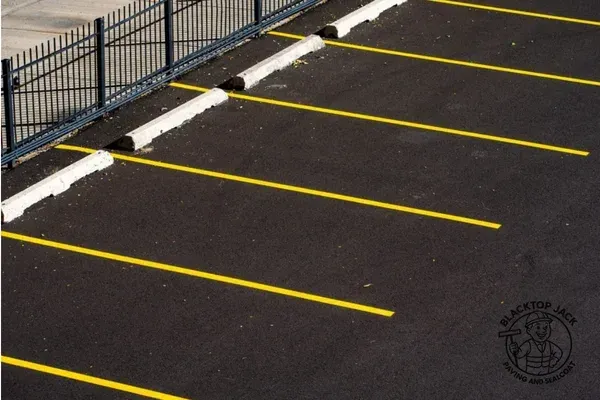
Commercial asphalt paving
Bucks County Commercial Paving: ADA Compliance & Line Striping Guide
A single non-compliant parking lot can expose a Bucks County business to an ADA lawsuit costing anywhere from a few thousand to well over $50,000 in legal fees and settlements, yet most property owners only discover their lot isn't compliant after a complaint has already been filed a risk that proper pavement maintenance and planning could have prevented entirely.
Quick Reference: ADA Parking Lot Requirements at a Glance
Requirement | Standard | Common Violation |
|---|---|---|
Accessible spaces required | 1 per 25 total spaces (minimum) | Too few spaces for lot size |
Van-accessible space ratio | 1 in every 6 accessible spaces | No van-accessible spaces designated |
Accessible space width | 96 inches minimum, plus access aisle | Spaces too narrow, no aisle marked |
Access aisle width | 60 inches minimum (96 for van spaces) | Aisle missing or too narrow |
Signage height | 60 inches minimum to bottom of sign | Signs too low or missing entirely |
Surface slope | 2% maximum in any direction | Excessive slope from poor grading |
Route to entrance | Continuous accessible path, no curbs without ramps | Broken or missing curb ramps |
If your lot is out of compliance with even one or two of these, you're carrying real legal exposure, regardless of how long you've operated without an issue. Maintaining an ADA compliant parking lot isn't a one-time task it requires ongoing attention as markings fade and pavement conditions change.
Why This Matters More Than Most Bucks County Business Owners Realize
If you own or manage a commercial property in Bucks County, you've probably thought about parking lot maintenance in terms of appearance and basic functionality: does it look presentable, are there potholes, does it need to be resurfaced soon. What often gets overlooked is that your parking lot is also a legal compliance surface, governed by specific, enforceable federal standards under the Americans with Disabilities Act.
This isn't a niche concern. ADA-related lawsuits targeting commercial parking lots have increased steadily over the past decade, and many are filed not because of a dramatic barrier to access, but because of something as simple as a faded line, an undersized accessible space, or missing signage. For a lot that hasn't been restriped or reassessed in years, the odds of a violation existing somewhere on the property are higher than most owners assume.
This guide walks through what actually matters for commercial properties here in Bucks County, why line striping is about more than curb appeal, and how proactive maintenance protects both your customers and your liability exposure.
What ADA Compliance Actually Requires
The ADA sets specific, measurable standards for commercial parking lots, and they go well beyond simply having a few marked accessible spaces near the entrance.
Number of accessible spaces. The required ratio scales with total lot size, starting at one accessible space for every 25 total spaces, with additional requirements as lot size increases.
Van-accessible spaces. A portion of your accessible spaces must specifically accommodate vans, which require wider access aisles than standard accessible spaces.
Proper dimensions and access aisles. Accessible spaces need specific minimum widths, paired with an adjacent access aisle that allows for safe entry and exit, particularly for wheelchair users.
Signage requirements. Each accessible space needs proper signage at a specified height, and van-accessible spaces require additional signage indicating that designation.
Surface and slope requirements. Accessible routes and spaces must maintain a maximum slope, since excessive grading can make a technically marked space functionally inaccessible.
Continuous accessible path. There needs to be an unbroken, curb-cut route from accessible parking all the way to the building entrance, without unramped curbs interrupting the path.
Why Line Striping Is About More Than Looks
It's easy to think of parking lot line striping as a cosmetic maintenance task, something you do to keep a lot looking fresh and organized. In reality, striping carries real functional and legal weight.
Faded lines create genuine safety hazards. When parking space boundaries, directional arrows, and pedestrian walkways become difficult to see, the risk of accidents, both vehicle-to-vehicle and vehicle-to-pedestrian, increases measurably.
Faded accessible markings are a direct ADA compliance issue. An accessible space with worn-away markings and no visible signage is functionally non-compliant, even if it was properly marked when it was first installed.
Striping also affects traffic flow and liability. Clear directional markings reduce confusion in busy lots, which lowers the likelihood of collisions that could expose a property owner to liability claims beyond ADA-specific issues.
Most parking lot line striping is designed to last one to three years depending on traffic volume and weather exposure, which means a lot that hasn't been restriped recently is very likely due, whether or not the fading is obvious at a glance.
How Pavement Condition Affects Compliance
ADA compliance isn't purely about paint the underlying pavement condition plays a direct role as well. Cracks, potholes, and uneven surfaces along accessible routes can violate the smooth, continuous path requirement, even if the space itself is properly marked and sized. This is exactly why commercial pavement maintenance and ADA compliance need to be addressed together rather than treated as separate projects.
A parking lot with deteriorating asphalt near an accessible space or along the route to the entrance isn't just a maintenance concern it's a compliance risk hiding inside what looks like a routine repair need.
A Practical Compliance and Maintenance Timeline
Action | Recommended Frequency | Purpose |
|---|---|---|
Full ADA compliance audit | Every 2–3 years, or after any restriping | Confirms spaces, aisles, and signage still meet current standards |
Line striping refresh | Every 1–3 years, depending on traffic | Maintains visibility and legal compliance of markings |
Surface inspection for cracks/potholes | Every 3–6 months | Identifies developing issues along accessible routes |
Sealcoating | Every 2–3 years | Protects surface and extends time between major repairs |
Signage check | Annually | Confirms signs remain visible, properly mounted, and undamaged |
Treating these as a connected schedule, rather than reactive one-off fixes, is what keeps a Bucks County commercial property both presentable and legally protected over time.
What Proactive Maintenance Actually Saves You
Beyond the legal exposure, there's a straightforward financial argument for staying ahead of both striping and general commercial asphalt paving upkeep. A faded striping job costs a modest, predictable amount to refresh on a routine schedule. An ADA complaint or lawsuit, by contrast, can involve legal fees, settlement costs, mandated remediation work done under time pressure, and reputational damage that's much harder to quantify but very real for a local business.
Routine maintenance is also simply cheaper than reactive repair in the way it almost always is with pavement: a small crack near an accessible route costs little to fix early, but left untreated through a few Bucks County winters, it can develop into a larger repair that also happens to be a compliance violation in the meantime. If you want a deeper look at how proactive care prevents this kind of compounding cost across any commercial or residential surface, our detailed resource on asphalt pavement maintenance breaks down exactly how early intervention saves money over the life of a property.
Frequently Asked Questions
Does my Bucks County business need an ADA-compliant parking lot even if it's small? Yes. An ADA compliant parking lot is required based on total parking space count, not overall business size. Even a small lot with under 25 spaces still requires at least one accessible space that meets full compliance standards.
How often should I have my parking lot professionally striped? Most commercial lots need restriping every one to three years, depending on traffic volume, weather exposure, and how the surface was sealcoated. High-traffic lots typically need it closer to the one-year mark.
Can I get in trouble for a lot that used to be compliant but has faded over time? Yes. ADA compliance isn't a one-time achievement it needs to be maintained. A lot that was properly marked when installed but has since faded to the point of being unreadable is generally considered non-compliant again.
Is sealcoating required for ADA compliance? Not directly, but sealcoating helps protect the surface that striping is applied to, and it plays a role in preventing the cracks and surface irregularities that can violate the accessible route requirements.
What's the difference between a standard accessible space and a van-accessible space? Van-accessible spaces require a wider access aisle than standard accessible spaces, since they need to accommodate wheelchair lifts or ramps that extend from the side of a van. A portion of your total accessible spaces must specifically meet this standard.
Who's responsible for ADA compliance the property owner or the business operating there? This can vary by lease agreement, but in most cases, the property owner bears primary responsibility for the physical parking lot, while tenant businesses may share responsibility for interior accessibility. It's worth clarifying this specifically in any commercial lease.
Bringing It All Together
For commercial property owners in Bucks County, a parking lot is more than a functional space for customers and employees to park it's a compliance surface with real legal weight, and a first impression that shapes how people perceive your business before they've even walked through the door. Staying ahead of both line striping and general pavement maintenance protects you on both fronts: reduced liability exposure and a property that consistently presents well.
Clear takeaway: ADA compliance and pavement condition aren't separate concerns they're connected, and treating them together through a consistent maintenance schedule is the most reliable way to protect both your customers and your business from unnecessary risk.
Protect Your Bucks County Property Today
Blacktop Jack provides commercial ADA compliance assessments, professional line striping, and complete pavement maintenance plans built specifically for Bucks County businesses, so you can stay compliant and protected without guesswork.