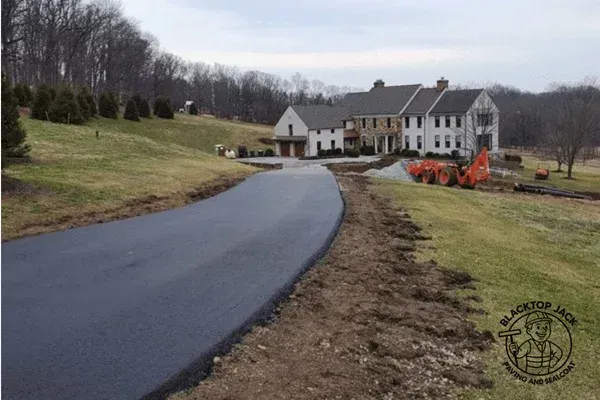
Hunterdon County Asphalt Paving: What Rural Properties Need to Know
Introduction:
Rural driveways in Hunterdon County average two to three times the length of a typical suburban driveway, yet most homeowners here still get quotes and maintenance advice written for a standard 40-foot suburban strip a mismatch that leads directly to poor pavement maintenance decisions and driveways that fail years ahead of schedule.
Quick Reference: Rural vs. Suburban Driveway Considerations
Factor | Suburban Driveway | Hunterdon County Rural Property |
|---|---|---|
Typical length | 30–60 feet | 150–500+ feet |
Base preparation needs | Standard compaction | More critical due to length and load variation |
Drainage complexity | Minimal grading needed | Often requires culverts, ditches, or cross-drains |
Material options | Almost always asphalt | Asphalt or tar and chip both common |
Snow removal | Simple, short pass | Longer plowing route; more wear per season |
Tree root exposure | Rare | Common along wooded driveway sections |
Cost per project | Lower overall | Higher overall, but often lower per linear foot |
If your property fits the right column, generic national paving advice is going to leave gaps that matter for your specific situation.
Why Rural Hunterdon County Properties Play By Different Rules
If you own a rural property in Hunterdon County, you already know your driveway isn't like the ones in nearby suburban developments. It's longer, it winds through trees or open fields, it might cross a culvert or handle runoff from a hillside, and it sees a genuinely different mix of traffic than a typical residential strip, from your own vehicles to delivery trucks, farm equipment, or contractors' trucks during a renovation.
Most paving advice online is written with that suburban driveway in mind. It assumes a short, flat, straightforward install with minimal grading complexity. Applied directly to a rural Hunterdon County property, that generic advice can miss the specific factors that actually determine whether your driveway holds up for two decades or starts failing within five. Real asphalt paving Hunterdon County projects need to account for these differences from the very first site visit.
This guide breaks down what rural properties in this county specifically need to think about, from installation through long-term care, so you're planning around your actual situation rather than a generic suburban template.
Base Preparation Matters Even More on Long Driveways
On a short suburban driveway, a slightly under-built base might not cause visible problems for several years, simply because there's less pavement for weak spots to develop in. On a 300-foot rural driveway, the math changes. More length means more opportunities for uneven ground, inconsistent compaction, or a section that was rushed to meet a schedule, and any of those weak points will eventually show up as cracking, rutting, or sinking somewhere along the run.
A properly built base for a long rural driveway typically requires more attention to consistency across the entire length, not just spot-checking a few sections. This means uniform compaction in layers, adequate depth throughout, and careful grading that accounts for any natural slope or drainage patterns along the property, rather than treating the driveway as one uniform, flat surface.
Drainage Planning Is a Bigger Deal Here Than in Town
Hunterdon County's rural terrain often means driveways cross natural drainage paths, sit near hillsides, or run through areas where water naturally wants to collect. A suburban driveway on a flat, engineered lot rarely deals with this complexity. A rural property might need culverts to let water pass underneath the driveway, roadside ditches to direct runoff away from the surface, or careful cross-sloping to prevent water from funneling down the length of a long driveway and eroding the edges or base over time.
Skipping proper drainage planning on a rural property doesn't just risk standing water, it risks water actively working against the driveway's structure across its entire length, which is a much bigger problem than a single low spot on a short suburban strip. This is exactly the kind of factor that generic paving advice, written without rural properties in mind, consistently underestimates.
Choosing Between Asphalt and Tar and Chip for a Rural Property
Rural Hunterdon County properties are one of the few settings where tar and chip is genuinely just as common a choice as traditional asphalt, and the decision often comes down to a mix of budget, aesthetic, and maintenance appetite specific to a longer driveway.
Tar and chip tends to suit long rural driveways well from a cost perspective, since installation is generally faster and less material-intensive per linear foot than full asphalt paving. It also blends naturally into wooded or open rural landscapes in a way that smooth black asphalt sometimes doesn't. The tradeoff is more hands-on upkeep, particularly loose stone management after snow plowing on a longer route.
Traditional asphalt, meanwhile, offers a more predictable surface for snow removal over a long distance and generally reaches a longer lifespan with consistent care. It requires a bigger upfront investment on a long driveway, but that cost is often offset by lower long-term maintenance demands if driveway maintenance is kept consistent.
What Actually Drives Asphalt Driveway Cost on Rural Properties
Understanding what factors into pricing helps you evaluate quotes realistically, since rural projects come with cost drivers that suburban quotes simply don't account for.
Length is the most obvious factor, but it's not the only one. Asphalt driveway cost on a rural property is also shaped by how much excavation and grading complexity the terrain requires, whether drainage infrastructure like culverts needs to be installed, how accessible the site is for heavy equipment, and whether tree roots or natural obstacles need to be worked around during installation.
A quote for a long rural driveway that seems surprisingly low compared to others is worth scrutinizing closely. On a project this size, the easiest place to cut costs without it being immediately obvious is base thickness and compaction quality, exactly the factors that matter most for a driveway's long-term durability.
Long-Term Maintenance for Rural Hunterdon County Driveways
Once your driveway is installed, ongoing pavement maintenance looks somewhat different on a rural property than it does on a short suburban strip, mainly due to scale and exposure. Consistent driveway maintenance matters even more here, since a small issue left unaddressed has more room to spread across a longer surface before it's noticed.
Seasonal inspections matter more here simply because there's more surface area to check, and problems can develop in sections you don't drive over daily if your property has multiple structures or a driveway that splits toward a barn, garage, or secondary building. Sealcoating, generally recommended every two to three years for asphalt, becomes a bigger single project on a long driveway, which is exactly why staying on schedule matters, since falling behind means a larger, more expensive catch-up job later rather than a series of manageable, routine ones.
Tree-lined sections deserve particular attention, since root growth can gradually affect the base beneath the pavement, and falling leaves and debris in wooded areas can trap moisture against the surface if not cleared regularly.
If you want a closer look at how professional paving and sealcoating work together as a complete service, especially relevant for a project of this scale, our detailed resource on paving and sealcoating breaks down what a full-service approach looks like from installation through ongoing protection.
What to Ask a Contractor Before Committing
Given how much rural properties differ from standard suburban jobs, it's worth asking a few specific questions before hiring anyone for an asphalt paving Hunterdon County project:
Do they have experience with long driveways and the base consistency challenges that come with them? How do they approach drainage planning for properties with natural slope or water flow to account for? Have they worked around tree roots or natural obstacles on similar rural jobs before? Can they walk you through how project cost scales with length and terrain complexity for your specific property?
A contractor who answers these with specific, confident detail is demonstrating real rural project experience, not just general paving familiarity. That distinction matters more here than it does for a standard suburban driveway.
Frequently Asked Questions
Is tar and chip a good choice for a long rural driveway in Hunterdon County? Often, yes. It tends to be more cost-effective per linear foot than asphalt on longer driveways and blends naturally into wooded or open rural settings, though it does require more ongoing stone maintenance.
How much more does a rural driveway cost compared to a suburban one? Total asphalt driveway cost is typically higher due to length, but cost per linear foot can actually be lower on longer driveways, depending on terrain and drainage complexity specific to your property.
Do I need special drainage infrastructure for my driveway? It depends on your property's natural slope and water flow. A site assessment can determine whether culverts, ditches, or cross-sloping are needed, which is something a rural-experienced contractor should evaluate before quoting your project.
How often should a long rural driveway be sealcoated? Generally every two to three years, the same as a standard driveway, though staying consistent matters even more here since a missed cycle on a long driveway means a larger, more expensive catch-up project later.
Can tree roots actually damage my driveway over time? Yes, particularly along wooded sections where root growth can gradually shift or crack the base beneath the pavement. Periodic inspection of tree-lined areas helps catch this before it becomes a larger repair.
What's the biggest mistake rural property owners make with driveway maintenance? Treating a long driveway the same as a short suburban one when it comes to inspection frequency. More surface area means more opportunity for small issues to develop unnoticed, so regular, full-length inspections matter more here.
Bringing It All Together
Rural properties in Hunterdon County genuinely need a different approach to driveway paving and care than a standard suburban lot, from base preparation and drainage planning through long-term maintenance scheduling. Applying generic, suburban-focused advice to a property like this leaves real gaps, exactly the kind that show up as premature cracking, drainage failures, or an unexpectedly large repair bill down the road.
Clear takeaway: Rural driveways demand rural-specific planning. Prioritize proper base preparation, thoughtful drainage design, and consistent pavement maintenance scaled to your property's actual length and terrain, and your driveway will perform the way a suburban one does, just built correctly for a very different kind of property.