Pavement Maintenance vs. Neglect: What 20 Years of Paving Taught Us
Introduction:
After two decades of paving driveways and parking lots, one pattern has held true on nearly every single job: we can tell within the first five minutes of walking a property whether its owner understood pavement maintenance or ignored it, and that five-minute assessment almost always predicts exactly how much the repair is going to cost.
If you're trying to figure out whether your own driveway or parking lot is on the right track, you're asking a smarter question than most people ever get around to. Most property owners only start thinking seriously about asphalt driveway maintenance after something's already gone wrong a pothole that showed up overnight, a crack that suddenly spread, a section that feels soft underfoot. By then, they're not really asking "how do I take care of this," they're asking "how bad is this, and how much is it going to cost."
We've walked thousands of properties over the years, and the same story plays out again and again. Two driveways installed the same year, by the same quality of contractor, using the same materials, end up in completely different conditions a decade later not because one got unlucky with weather or traffic, but because one owner treated pavement maintenance as routine and the other treated it as optional.
This isn't theory. It's a pattern we've watched repeat on property after property, and it's worth breaking down exactly what separates these two outcomes, because the lessons are more useful than almost any generic maintenance checklist.
The Two Driveways We See Most Often
Over the years, nearly every property we assess falls into one of two broad categories, and the differences show up in predictable, specific ways.
The maintained driveway usually still has a relatively dark, even surface color, even if it's a few years old. Cracks, when present, are thin and recently sealed. The edges are intact, without crumbling or vegetation growing through gaps. Drainage is doing its job no standing water, no visible erosion near the surface. The owner, when we talk to them, usually has a rough sense of when they last had it sealcoated, even if it wasn't recent.
The neglected driveway tells a very different story before we even get out of the truck. The surface has faded to gray, sometimes with a chalky texture. Cracks have branched into networks, sometimes with grass or weeds growing through them. There are often soft spots or early sinking near low points where water regularly pools. When we ask the owner about their maintenance history, the answer is almost always some version of "I don't think we've ever had anything done to it."
The wild part is that both driveways often started out identical. Same installation quality, same asphalt mix, same climate exposure. The only real difference is what happened or didn't happen in the years after installation.
What 20 Years Has Taught Us About How Damage Actually Progresses
Textbooks describe asphalt deterioration in fairly clinical terms: oxidation, water infiltration, base failure. What two decades in the field actually teaches you is how those processes play out in real conditions, on real properties, with real consequences.
Damage doesn't announce itself early. The properties that end up in the worst condition almost never had a dramatic failure event. They had years of small, ignorable signs slight fading, a hairline crack here and there that simply never got addressed because nothing looked urgent enough to act on.
The first year after installation matters more than people think. We've seen driveways that got their first sealcoat within the first year hold up dramatically better than identical driveways where the first sealcoat didn't happen until year five or six, by which point measurable oxidation damage had already occurred.
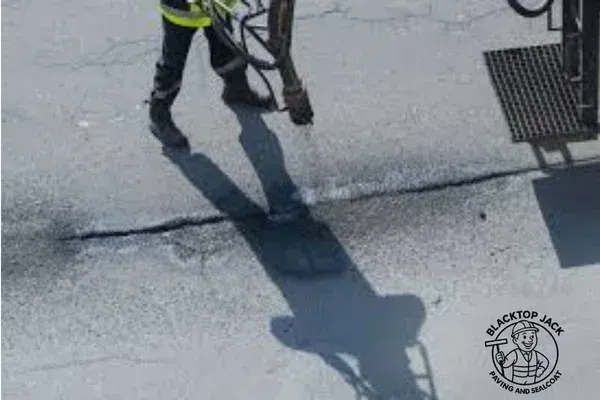
Small crack sealing has the best return of anything we do. If we had to pick the single highest-impact, lowest-cost maintenance action across every job we've done, it's sealing small cracks promptly. It's inexpensive, it's fast, and it reliably prevents the water infiltration that leads to almost every serious asphalt repair we're eventually called out for.
Neglect compounds faster than most people expect. A driveway that goes five years without any attention isn't five years behind a well-maintained one it's often closer to ten years behind in terms of remaining structural life, because each untreated crack accelerated the ones that formed after it, eventually turning a simple maintenance visit into a full asphalt driveway repair job.
A Field Comparison: What 10 Years Looks Like on Both Paths
Here's a realistic side-by-side, based on patterns we've observed repeatedly across real properties over the years.
Year | Maintained Driveway | Neglected Driveway |
|---|---|---|
1 | First sealcoat applied; surface protected early | No action taken; oxidation begins unchecked |
3 | Minor cracks sealed as they appear | First visible cracks appear, left untreated |
5 | Second sealcoat cycle begins | Cracks have widened; water infiltration underway |
7 | Surface still dark, structurally sound | Base weakening begins; soft spots appear |
10 | Minor spot asphalt driveway maintenance only | Potholes forming; asphalt driveway repair likely needed |
This is a pattern we've watched play out on property after property, almost regardless of climate or region. The starting point is identical. The divergence is entirely a function of what happened, or didn't happen, in between.
The Properties That Surprised Us Most
Not every case fits the obvious pattern, and the exceptions have taught us just as much as the rule.
We've seen driveways in genuinely harsh climates heavy freeze-thaw cycling, significant salt exposure hold up remarkably well simply because the owner was disciplined about sealing cracks every fall before winter hit. Meanwhile, we've seen driveways in comparatively mild climates fail well ahead of schedule because they went years without any attention at all. Climate matters, but consistency matters more.
We've also seen the opposite mistake: owners who sealcoated regularly but ignored actual cracks in between applications, essentially sealing a protective layer over damage that was still actively letting water in underneath. Sealcoating without crack sealing is like painting over a hole instead of patching it it looks better temporarily but doesn't solve the underlying problem.
The lesson from both of these cases is the same: asphalt repair and prevention aren't separate categories you choose between. Real asphalt driveway maintenance requires addressing both surface protection and structural issues as they arise, not picking one and assuming it covers the other.
What We Tell Every Property Owner Now
After enough repeat patterns, you start giving the same advice regardless of the property in front of you, because the fundamentals genuinely don't change much from job to job.
Don't wait for damage to look serious before acting. The properties in the best condition after a decade weren't the ones with the fewest problems they were the ones where small problems got addressed while they were still small.
Treat the first year after installation as critical. New asphalt is at its most vulnerable to UV oxidation before its first protective seal coat. Scheduling that first application within 6 to 12 months makes a measurable long-term difference.
Don't confuse sealcoating with crack repair. They serve different purposes. Sealcoating protects the surface; crack sealing prevents water from compromising the base underneath. Both are necessary, and neither substitutes for the other and skipping either one is usually what turns a routine job into an unplanned asphalt driveway repair.
Get an honest assessment if you're not sure where you stand. Plenty of property owners genuinely don't know whether their pavement maintenance is on track or heading toward trouble, simply because they've never had a professional look at it with that specific question in mind.
When Neglect Has Already Taken Hold
If what you're reading here sounds closer to the neglected column than the maintained one, you're not alone it's the more common starting point we encounter, not the exception. The good news is that even pavement with years of deferred care can usually be brought back to a stable, maintainable condition, though it typically requires an asphalt driveway repair to address existing damage before a routine asphalt driveway maintenance schedule can be effective going forward.
We've written extensively about what happens on properties where maintenance was skipped for years before anyone stepped in, including the specific patterns of damage that tend to show up and what it actually takes to reverse course. If that sounds like where your property currently stands, our detailed case-based breakdown on ignored pavement maintenance walks through exactly what we typically find on properties in this situation, and the realistic path back to stable, well-protected pavement.
The Pattern That Never Changes
If two decades in this industry has taught us anything, it's that pavement doesn't reward good intentions it rewards consistency. The driveways and parking lots that last hold up not because their owners did anything extraordinary, but because they did a handful of ordinary things, at the right time, over and over again. The ones that fail early almost never fail because of a single bad decision. They fail because of years of small, reasonable-sounding decisions to wait just a little longer.
Clear takeaway: Twenty years of fieldwork has shown us the same thing on property after property consistent pavement maintenance beats reactive repair every time, and the properties that skip it don't save money, they just delay and inflate the bill.